



- This event has passed.
Yajur Upākarmā & Gāyatrī Japam: August 27 & Aug 28
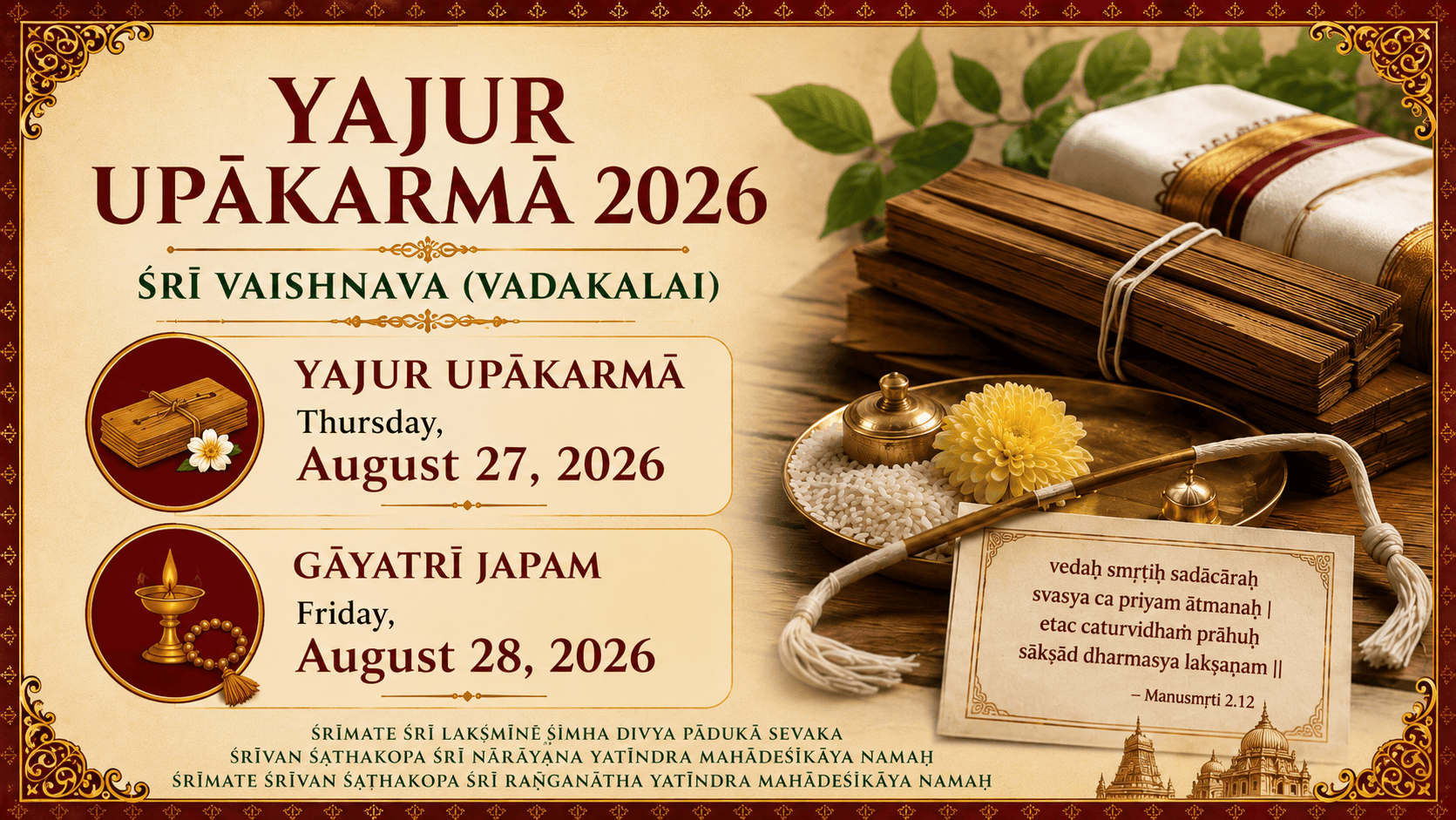
Yajur Upākarmā: Thursday, August 27, 2026
Gāyatrī Japam: Friday, August 28, 2026
Yajur Upākarmā will be observed on Thursday, August 27, 2026, followed by
Gāyatrī Japam on Friday, August 28.
A lunar eclipse will occur during the late evening or night of August 27
and will be visible in parts of Europe, the Middle East, Asia, Africa, and
North and South America.
Questions Addressed
- Does the lunar eclipse affect Yajur Upākarmā performed that morning?
- Does it affect those performing śrāddham later that afternoon?
The guidance below is based on the rules stated in the
Āhnika Grantham authored by His Holiness Śrīmad Villivalam
Azhagiyasingar, the 45th Jeer of Śrī Ahobila Maṭham. Two Śrī Sannidhi
ārādhakars were also consulted.
1. Second and Subsequent Yajur Upākarmā
The second and all subsequent Yajur Upākarmā observances must be performed
on the Paurṇamī tithi of the month of Śrāvaṇa.
The date is not affected by doṣas or ritual blemishes associated with:
- Saṅkramaṇam
- Grahaṇam
- Mala māsa
- Other similar conditions
Unlike śrāddham, eating or partaking of Perumāḷ prasādam is not an integral
part of the Upākarmā ritual.
However, the rules associated with the lunar eclipse require fasting for
approximately three yāmas, or nine hours, before the eclipse begins.
Avoid eating after approximately this time.
1:52 AM (Aug 28)
Avoid eating after approximately this time.
Most people complete Upākarmā during the morning. Temple batches generally
run from sunrise until mid-morning, allowing sufficient time to complete
the observance and eat before the eclipse-related fasting period begins.
Conclusion
Yajur Upākarmā must be observed on Thursday, August 27, 2026.
Participants should complete the observance and eat before the
eclipse-related fasting restriction begins.
2. Prathama Yajur Upākarmā
The above rule does not automatically apply to brahmacārīs observing their
first Upākarmā after upanayanam.
The first Upākarmā performed after upanayanam is known as
Prathama Upākarmā.
For Prathama Upākarmā, the selected Paurṇamī must be free from ritual
blemishes and must fall in one of the following months:
- Āṣāḍha
- Śrāvaṇa
- Proṣṭhapada
Prathama Upākarmā should not be observed on a Paurṇamī affected by:
- Saṅkramaṇam
- Grahaṇam
- Guru or Śukra mauḍhyam
- Mala māsa
Families arranging a youngster’s first Upākarmā should consult their
elders or family vādhyār before fixing the date.
Prathama Gāyatrī Japam
Prathama Gāyatrī Japam is free from these blemishes and should be
performed on Friday, August 28, 2026.
3. Śrāvaṇa Paurṇamī Śrāddham
Śrāddham is normally performed during the early or mid-afternoon period
known as aparāhna kālam.
Unlike Upākarmā, the following are directly connected with the śrāddham
ritual:
- Bhojanam for the bhoktā
- Partaking of pitṛ-śeṣam by the kartā
- Partaking of pitṛ-śeṣam by the kartā’s family
Because the lunar eclipse occurs on the same day and the fasting restriction
affects the required bhojanam, the Śrāvaṇa Paurṇamī śrāddham should be
postponed to the following day.
Grahaṇa tarpaṇam must be performed on the eclipse tithi itself. The
śrāddham belonging to that tithi must be performed on the following day,
even when the following day has a different tithi.
Those required to perform Śrāvaṇa Paurṇamī śrāddham should consult their
elders or family vādhyār regarding the proper observance.
Summary
Regular Yajur Upākarmā
Observe on Thursday, August 27, 2026. Complete the
observance and eat before the eclipse fasting restriction begins.
Prathama Upākarmā
Consult the family vādhyār or knowledgeable elders before fixing the
date.
Gāyatrī Japam
Perform on Friday, August 28, 2026.
Śrāddham
Perform grahaṇa tarpaṇam on the eclipse tithi and the corresponding
śrāddham on the following day, after consulting the family vādhyār.
Questions or Clarifications
Contact Sri Ahobila Muth Inc. at
sriahobilamuthinc@gmail.com
Śrīmate Śrī Lakṣmīnṛsiṃha Divya Pādukā Sevaka Śrīvaṇ Śaṭhakopa
Śrī Nārāyaṇa Yatīndra Mahādeśikāya Namaḥ
Śrīmate Śrīvaṇ Śaṭhakopa Śrī Raṅganātha Yatīndra
Mahādeśikāya Namaḥ